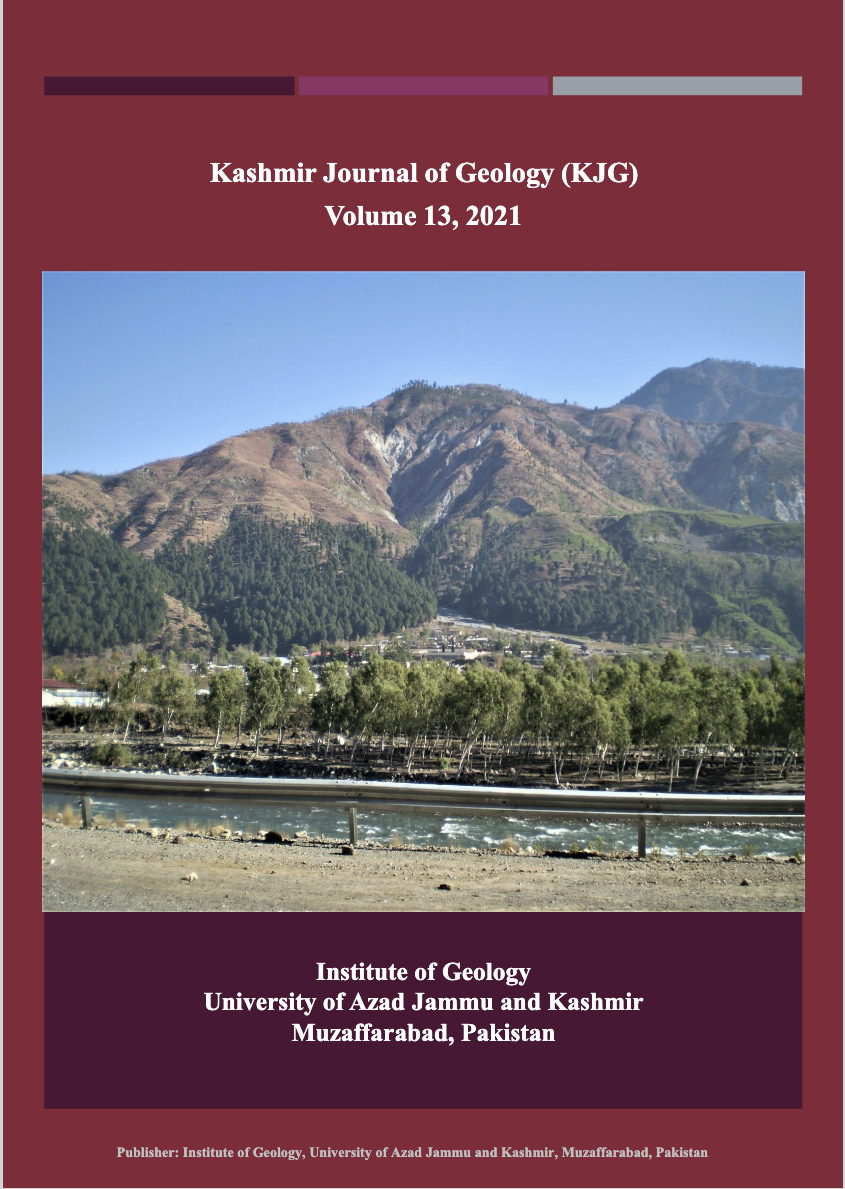
Microfacies analysis and depositional environment of the Cambrian Ambar Formation, Peshawar Basin, Pakistan
Keywords:
Cambrian, Ambar Formation, Microfacies, Inner ShelfAbstract
The Cambrian Ambar Formation is composed of massive
dolomite, dolomitic limestone, limestone, quarzitic dolomite, and
sandy limestone. It is exposed in the Swabi and Turlandi areas,
the northeastern part of the Peshawar Basin. The present study
deals with the sedimentological and petrographical aspects of the
Ambar Formation. Algal laminated beds, dissolution cavities,
chop-board weathering, stylolites, quartz, and calcite filled
fractures together with open fractures are prominent in the
outcrops. Based on microscopic studies, three microfacies are
identified: (1) Siliciclastic Mudstone Microfacies (MF-1), (2)
Dolomitic Packstone Microfacies (MF-2) and (3) Dolomitic
Packstone-Grainstone Microfacies (MF-3) without taking
consideration of the lithofacies in a single outcrop exposed in the
studied section. The integration of the outcrop and petrographic
observations indicate transitional to inner carbonate shelf setting
ranging from supratidal to lagoon during the deposition of the
Ambar Formation.
Downloads
Published
Issue
Section
License
Copyright (c) 2021 Rafique Ahmad, Fahad Ali, Bilal Sadaqat, Taqweem ul Haq Ali, Abdul Mateen, Muhammad Idrees ur Rehman, Mutahir Siddique, Hammad Ullah (Author)

This work is licensed under a Creative Commons Attribution 4.0 International License.